
With our Sand Calculator, estimate exact sand quantities in cubic yards, cubic meters, tons, tonnes, bags, or brass for any shape or project.
Estimated Sand Required
Includes 10% compaction & wastePlanning estimate only. Actual sand weight varies with moisture content (wet sand can weigh 15–20% more than dry sand) and site compaction. Always confirm bulk density and delivery minimums with your local supplier.
Calculating sand accurately before placing an order is the single easiest way to prevent a stalled weekend project or an unexpected second delivery fee. Whether you are leveling a patio base, sweeping joint sand between concrete pavers, filling a backyard sandbox, or setting up a planted fish tank, this Sand Calculator converts your exact dimensions into cubic yards, cubic meters, cubic feet, US short tons, metric tonnes, retail bags, and local currency costs in seconds.
Sand remains one of the highest-volume materials in global construction and landscaping. According to the U.S. Geological Survey 2026 Mineral Commodity Summaries, U.S. construction sand and gravel production reached 870 million tons in 2025, with 42% used in concrete aggregates, 20% in road base and coverings, and 12% in construction fill.
Why Guessing Sand Quantities Costs More Than You Think
Picture a homeowner building a 16 ft × 12 ft paver patio on a Saturday morning. He eyeballs the space, estimates “maybe half a yard of sand,” and drives to the local landscape yard with a utility trailer. By noon, after compacting the bedding layer with a plate tamper, he realizes the 1-inch sand bed compressed by nearly 15% and left the final four feet of the patio bare.
Because the landscape yard closes at 1:00 PM on Saturdays, the entire project sits half-finished until Monday, or worse, he ends up buying 18 individual 50-pound retail bags at three times the per-ton bulk price just to finish the job.
That mistake happens for three predictable reasons:
- Loose vs. compacted volume: Sand is sold by loose volume or scale weight, yet almost every construction base layer is tamped or wetted down, reducing its installed thickness by 10% to 15%.
- Moisture weight swings: Dry river sand weighs roughly 100 lb/ft³ (1,600 kg/m³), whereas damp sand stored outdoors after rain can weigh 115 to 120 lb/ft³ (1,850 to 1,920 kg/m³). Buying by the ton when sand is wet gives you 15% to 20% less volume per ton than expected.
- Different sand types have different jobs: Sharp concrete sand locks pavers in place, polymeric sand hardens inside narrow joints, washed play sand protects children from silica dust, and inert aquarium sand buffers aquatic setups without clouding water.
How to Use the MeterCrest Sand Calculator
This tool is built for both DIY homeowners and trade contractors working in imperial or metric units:
- Choose your Region & Unit Preset: Select Global, US (Imperial), UK / Europe (Metric), Australia (Metric), or India (CFT / Brass). The calculator automatically adapts length units (
ft/invs.m/mm), bag weights (50 lb,25 kg,20 kg,50 kg), currency symbols, and regional bulk units such as US short tons, metric tonnes, 850 kg dumpy bags, or Indian Brass (100 ft³). - Pick a Quick Project Depth Preset (or enter custom depth): Click Paver Base (1 in / 25 mm), Sandbox (8 in / 200 mm), Pool Base (2 in / 50 mm), Leveling / Sod (1.5 in / 40 mm), or Trench / Sub-base (4 in / 100 mm) to auto-fill industry-standard depths and bulk densities.
- Enter Area Dimensions & Shape: Measure your project as a Rectangle / Square, Circle / Round (ideal for round above-ground pools, fire pits, or circular sandboxes), Triangle, or Known Surface Area. Need to combine a patio, walkway, and side landing? Click + Add Another Area / Section to total multiple zones at once.
- Adjust Sand Type & Compaction Allowance: Leave the Compaction & Waste Allowance at 10% for standard tamping and spillage (or increase to 15% for deep fills and irregular edges).
- Add Optional Pricing & Click Calculate Sand Needed: Enter your supplier’s quote per ton, per cubic yard, per cubic meter, or per bag, then click Calculate Sand Needed to view your full breakdown and print or save a PDF job sheet.
The Core Formula for Calculating Sand
Every sand volume calculation starts with a straightforward geometric formula, followed by a bulk-density conversion to find weight:
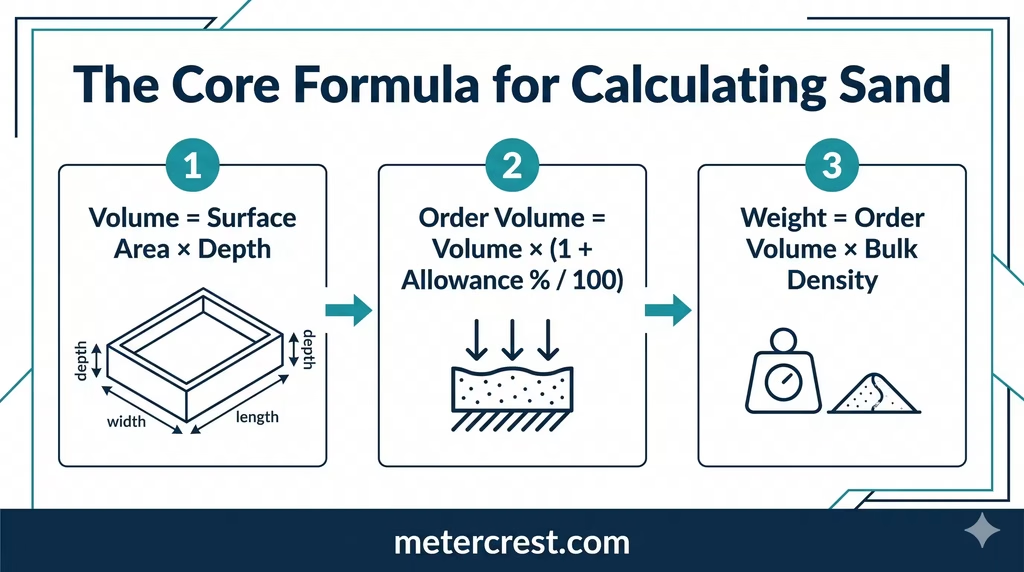
How to Calculate Yards of Sand (US Imperial Formula)
To calculate the cubic yards of sand required, you need three measurements: length in feet, width in feet, and depth in inches.
Since the dimensions are measured in different units, first convert the sand depth from inches to feet by dividing it by 12. Then, divide the total cubic feet by 27 to convert the volume into cubic yards.
Formula: Cubic Yards = (Length × Width × (Depth ÷ 12)) ÷ 27
Where:
- Length = Area length in feet (ft)
- Width = Area width in feet (ft)
- Depth = Sand depth in inches (in)
- 27 = Number of cubic feet in one cubic yard
Quick Shortcut Formula: Cubic Yards = (Length × Width × Depth) ÷ 324
This shortcut combines both conversions (12 × 27 = 324), allowing you to calculate cubic yards of sand directly without performing separate unit conversions.
How to Calculate Cubic Meters & Tonnes (Metric Formula)
To calculate sand volume in cubic meters, multiply the length and width (in meters) by the depth (in millimeters) divided by 1,000.
Cubic Meters (m³) = Length (m) × Width (m) × (Depth (mm) ÷ 1,000)
To convert the volume into metric tonnes, multiply cubic meters by the sand’s bulk density (kg/m³) and divide by 1,000.
Metric Tonnes = (Cubic Meters × Bulk Density) ÷ 1,000
Sand Bulk Density Reference Chart by Sand Type
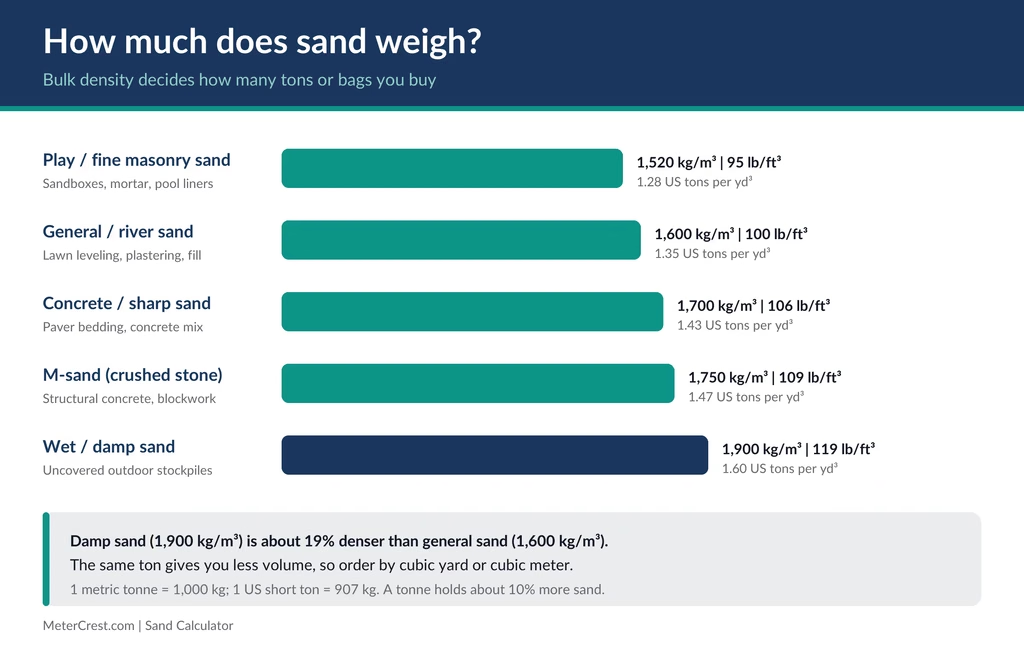
When calculating sand, weight depends directly on grain size, mineral composition, and moisture content. Use these benchmark densities when converting between volume and tonnage:
| Sand Type | Typical Use Case | Bulk Density (kg/m3) | Bulk Density (lb/ft3) | Weight per yd3 (US Tons) |
| Play / Fine Masonry Sand | Sandboxes, mortar joints, pool liners | 1,520 | 95 | 1.28 tons |
| General / River Sand | Lawn leveling, plastering, general fill | 1,600 | 100 | 1.35 tons |
| Concrete / Sharp Sand | Paver bedding base, concrete mix | 1,700 | 106 | 1.43 tons |
| M-Sand (Crushed Stone Sand) | Structural concrete, blockwork (India/Asia) | 1,750 | 109 | 1.47 tons |
| Wet / Damp Sand | Uncovered outdoor stockpiles | 1,900 | 119 | 1.60 tons |
Note: One metric tonne equals 1,000 kg (2,204.6 lb), whereas one US short ton equals 2,000 lb (907.2 kg). A metric tonne contains roughly 10.2% more sand than a US short ton.
Paver Sand Calculator Guide: Bedding Layer vs. Joint Sand
A paver sand calculator actually solves two completely different steps of a hardscape installation: the compacted bedding layer underneath the pavers and the joint-stabilizing sand swept between them. Mixing up the two materials is one of the most common hardscape failures.
1. Calculating Bedding Sand Under Pavers
Beneath concrete pavers or natural stone, industry guidelines from the Concrete Masonry & Hardscapes Association (CMHA) and manufacturer data sheets (such as Alliance Gator’s technical specifications) call for a 1-inch (25 mm) screeded layer of coarse, angular concrete sand (ASTM C33) installed over 4 to 6 inches (100–150 mm) of compacted crushed aggregate base. Never use fine play sand or mason’s sand for a bedding layer—its rounded grains roll under load and cause pavers to sink and rut.
Worked Example — 20 ft × 15 ft Patio Base:
- Surface Area: 20 ft × 15 ft = 300 sq ft
- Bedding Depth: 1 inch (0.0833 ft)
- Net Volume: 300 × 0.0833 = 25 ft³ (0.93 yd³ or 0.71 m³)
- With 10% Compaction Allowance: 1.02 yd³ (0.78 m³)
- Weight (Concrete Sand at 106 lb/ft³): 27.5 ft³ × 106 lb = 2,915 lb (1.46 US tons or 1.32 metric tonnes)
If you are also building a brick border, retaining wall, or garden edging around your patio, pair this estimate with our Brick Calculator to calculate exact brick counts and mortar ratios for the perimeter.
2. Polymeric Sand Calculator & Dominator Polymeric Sand Coverage
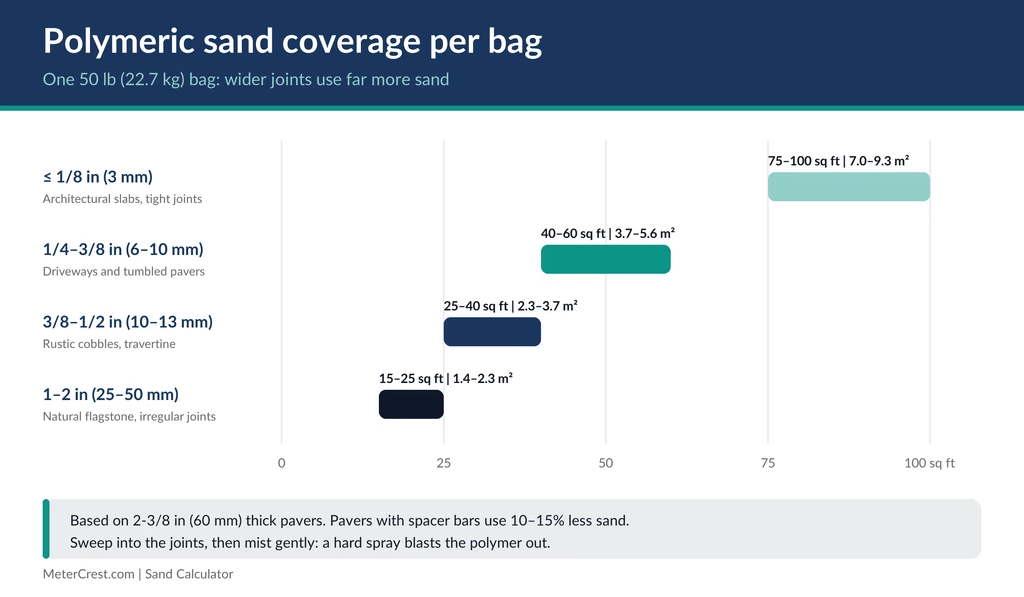
Once your pavers are laid and compacted, you sweep polymeric sand into the gaps and mist it with water so the polymer binders lock the pavers together, block weeds, and resist washout.
Unlike bedding sand, which is measured by cubic volume, a polymeric sand calculator depends primarily on joint width, paver thickness, and stone size. Narrow joints between large slabs use very little sand, while wide joints between small cobbles or irregular flagstone consume three to four times as much.
Coverage Guide per 50 lb (22.7 kg) Bag of Polymeric Sand
Whether you are using Dominator Polymeric Sand, Alliance Gator G2 / Maxx, or Techniseal, standard 50 lb (22.7 kg) bags follow consistent industry coverage ranges for 2-3/8 in (60 mm) thick pavers:
| Joint Width | Coverage per 50 lb (22.7 kg) Bag | Typical Paver Application |
|---|---|---|
| Narrow (≤ 1/8 in / 3 mm) | 75–100 sq ft (7.0–9.3 m²) | Architectural slabs and tight-joint concrete pavers |
| Medium (1/4–3/8 in / 6–10 mm) | 40–60 sq ft (3.7–5.6 m²) | Residential driveways and tumbled pavers |
| Wide (3/8–1/2 in / 10–13 mm) | 25–40 sq ft (2.3–3.7 m²) | Rustic cobbles, travertine and deep-bevel pavers |
| Extra-Wide / Flagstone (1–2 in / 25–50 mm) | 15–25 sq ft (1.4–2.3 m²) | Natural flagstone and irregular stone joints |
Note on spacer bars: Pavers molded with integrated spacer bars require 10% to 15% less polymeric sand than smooth-sided pavers of the same nominal joint width.
Sandbox Sand Calculator & Play Sand Guide
When using a sandbox sand calculator or play sand calculator, depth and material safety matter far more than compaction.
Children need enough depth to dig tunnels and mold sandcastles without hitting the landscape fabric underneath, while parents need washed, rounded-grain sand free of respirable crystalline silica dust and sharp crushed stone fragments.
Recommended Sandbox Depths
- Toddler Sandboxes (Ages 2–4): 6 inches (150 mm) of play sand.
- Standard Backyard Sandboxes (Ages 4–10): 8 to 10 inches (200–250 mm) of play sand.
- Large Community or School Sand Pits: 12 inches (300 mm) of play sand over a geotextile weed barrier and pea-gravel drainage bed.
Worked Example: How to Calculate Sandbox Sand?
Suppose you build an 8 ft × 8 ft wooden sandbox and want a 9-inch layer of play sand (bulk density 95 lb/ft³ or 1,520 kg/m³):
- Surface Area: 8 ft × 8 ft = 64 sq ft
- Depth in Feet: 9 in ÷ 12 = 0.75 ft
- Net Volume: 64 × 0.75 = 48 ft³ (1.78 yd³ or 1.36 m³)
- Total Weight: 48 ft³ × 95 lb/ft³ = 4,560 lb (2.28 US tons or 2.07 metric tonnes)
- 50 lb Play Sand Bags Needed: 4,560 ÷ 50 = 91.2, rounded up to 92 bags (or 83 bags of 25 kg in the UK/Europe).
Pro Tip: At nearly 1.8 cubic yards, buying 92 individual bags at a big-box store will cost roughly $450 to $550 and require multiple car trips. Ordering 2 cubic yards of washed play sand delivered in bulk from a landscape supplier typically costs $90 to $160 plus delivery, saving hundreds of dollars.
Aquarium Sand Calculator & Substrate Bed Guide
An aquarium sand calculator (or aquarium sand bed calculator) works on the exact same volume-times-density math as landscaping, scaled down to inches or centimeters and pounds or kilograms. Because aquarium sand is denser than porous aquasoil or coarse gravel, a little goes a long way.
Recommended Aquarium Sand Bed Depths
- Fish-Only / Bare-Style Display Tanks: 1 to 1.5 inches (2.5–4 cm) — enough to cover the bottom glass and host nitrifying bacteria without trapping anaerobic gas pockets.
- Bottom-Dweller Tanks (Corydoras, Loaches, Geophagus): 1.5 to 2 inches (4–5 cm) of smooth, fine silica or pool-filter sand so barbels are never abraded.
- Low-Tech Planted Aquariums: 2 to 3 inches (5–8 cm), often sloped from 1.5 inches in front to 3 inches at the back for visual depth and root anchorage.
- High-Tech Carpeted or Dirted (Walstad) Tanks: 1 inch of organic soil capped with 1.5 to 2 inches (4–5 cm) of fine sand.
The Aquarium Pound-per-Gallon Rule vs. Exact Tank Dimensions
A common aquarium rule of thumb states that 1 pound of sand per gallon of tank water creates roughly a 1-inch sand bed (or 1.5 to 2 lb per gallon for a 2-inch planted bed).
However, tall tanks and bow-front tanks have very different footprints for the same gallon rating, so measuring the glass footprint directly is far more accurate:
Aquarium Sand (lb) = (Tank Length (in) × Tank Width (in) × Desired Sand Depth (in) ÷ 1,728) × 100
Worked Example: 40-Gallon Breeder Tank (36 in × 18 in) with 2-Inch Sand Bed:
- Substrate Volume: (36 × 18 × 2) ÷ 1,728 = 0.75 ft³ (21.2 liters)
- Sand Weight (at 100 lb/ft³): 0.75 × 100 = 75 lb (34 kg)
- With 10% Rinsing & Settling Buffer: Order 80 to 85 lb (e.g., four 20 lb bags or two 40 lb bags). Always rinse dry aquarium sand in a bucket until the water runs clear before adding it to your tank to prevent days of milky water.
Bulk Delivery vs. Retail Bags: When Should You Switch?
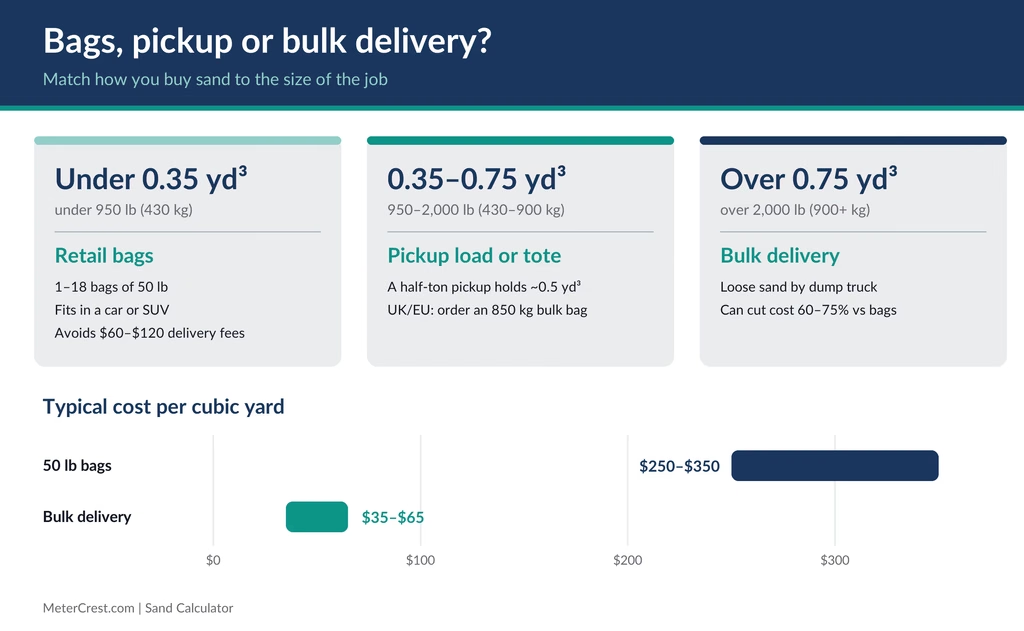
One of the easiest ways to overspend on a sand project is buying retail bags for a bulk-sized job or paying a dump-truck delivery minimum for a tiny patch. Use the 0.50 cubic yard (0.38 cubic meter) crossover rule:
| Project Volume | Equivalent Weight | Best Buying Method | Why It Wins |
|---|---|---|---|
| Under 0.35 yd³ (0.27 m³) | Under 950 lb (430 kg) | Retail Bags (1–18 bags of 50 lb) | Easy to transport in a car or SUV and avoids $60–$120 minimum delivery fees. |
| 0.35–0.75 yd³ (0.27–0.57 m³) | 950–2,000 lb (430–900 kg) | Pickup Truck Load or Bulk Tote Bag | A half-ton pickup can hold approximately 0.5 yd³. UK/EU buyers can order an 850 kg bulk bag. |
| Over 0.75 yd³ (0.57 m³) | Over 2,000 lb (900+ kg) | Loose Bulk Delivery (Dump Truck) | Costs approximately $35–$65 per yd³ compared with $250–$350 per yd³ for 50 lb bags, potentially saving 60%–75%. |
5 Costly Mistakes to Avoid When Ordering Sand
- Forgetting to Convert Inches to Feet: Entering
16 ft × 12 ft × 2without converting2 inchesto0.167 feetinflates your sand order by 12× (turning a 1.2-yard patio order into 14.2 cubic yards). Always verify the unit dropdown next to each box. - Skipping the Compaction Allowance: Screeding 1 inch of loose concrete sand and running a plate compactor over it compresses the bed to roughly 0.85 inches. Adding 10% in the calculator ensures you still hit your target finished grade.
- Using Mason Sand Under Pavers: Fine mason sand or play sand lacks angular edges and washes out easily, leading to sunken pavers after the first heavy rainstorm. Always specify washed concrete sand (ASTM C33) for paver bedding.
- Hosing Down Polymeric Sand Too Hard: After sweeping polymeric sand into paver joints, use a gentle shower nozzle rather than a jet spray. High water pressure blasts polymer binders out of the joints and leaves a white haze across the stone surface.
- Ordering by Weight Without Checking Moisture: Rain-soaked sand can be denser than dry sand, meaning 1 ton of wet sand may occupy up to 15% less volume. When buying from outdoor suppliers, order by cubic volume (yd³ or m³) rather than weight whenever possible.
Explore more construction, masonry, and home improvement estimators on the MeterCrest to plan every stage of your build with confidence.
FAQs
How many square feet does 1 cubic yard of sand cover?
One cubic yard of sand covers 324 square feet at 1 inch deep, 162 square feet at 2 inches deep, 108 square feet at 3 inches deep, and 81 square feet at 4 inches deep. Divide 324 by your desired depth in inches to find exact coverage per cubic yard.
How much does a cubic yard of sand weigh?
A cubic yard of dry general or river sand weighs approximately 2,700 lb (1.35 US tons or 1.22 metric tonnes), based on an average density of 100 lb/ft³ (1,600 kg/m³). Coarse concrete sand weighs around 2,860 lb (1.43 US tons), while wet sand can exceed 3,200 lb (1.60 US tons).
How many 50 lb bags of sand are in a cubic yard?
It takes approximately 54 bags of 50 lb sand to make 1 cubic yard (2,700 lb ÷ 50 lb = 54 bags). For 40 lb bags, you need about 68 bags per cubic yard, while 1 cubic meter requires approximately 64 bags of 25 kg sand.
How much polymeric sand do I need per square foot?
For standard concrete pavers with 1/8-inch joints, one 50 lb bag of polymeric sand (such as Dominator or Alliance Gator G2) covers approximately 75–100 sq ft. For wider 1/4- to 3/8-inch joints, coverage drops to 40–60 sq ft per bag, while wide flagstone joints typically cover 15–25 sq ft per bag.
How much sand do I need for an 8×8 sandbox?
An 8 ft × 8 ft sandbox filled to a 6-inch depth requires 32 ft³ (1.19 yd³) of play sand, weighing approximately 3,040 lb or 61 bags (50 lb each). At an 8-inch depth, it requires 42.7 ft³ (1.58 yd³), or approximately 81 bags (50 lb each).
How much sand do I need for my aquarium?
For a standard 1-inch sand bed, estimate approximately 1 lb of aquarium sand per gallon of tank capacity. For a 2-inch planted aquarium substrate, multiply the tank’s length, width, and desired depth (in inches), divide by 1,728, and multiply by 100 to estimate the sand weight in pounds. Add 10% extra to account for rinsing losses.
How many cubic feet are in 1 Brass of sand?
In India and South Asia, 1 Brass of sand equals 100 cubic feet (ft³), or approximately 2.83 cubic meters (m³) and 3.70 cubic yards (yd³). It typically weighs around 4.5–4.9 metric tonnes, depending on moisture content and whether river sand or manufactured sand (M-sand) is used.