
With our Brick Calculator, estimate bricks, mortar, cement, sand, and cost for walls anywhere in the world — metric or imperial, with brick sizes from the US, UK, Australia, India, Germany, and South Africa.
Add each wall section of your project. The unit next to each field converts automatically.
Standard single-leaf (half-brick) walls with a 10 mm mortar joint. Double the count for a full-brick wall.
| Region / Standard | Brick size (mm) | Bricks / m² | Bricks / ft² |
|---|---|---|---|
| UK Standard | 215 × 102.5 × 65 | 59 | 5.5 |
| US Modular | 194 × 92 × 57 | 73 | 6.8 |
| US Standard | 203 × 102 × 57 | 70 | 6.5 |
| Australia | 230 × 110 × 76 | 48 | 4.5 |
| India Traditional | 230 × 110 × 75 | 49 | 4.6 |
| India Modular (IS) | 190 × 90 × 90 | 50 | 4.6 |
| Germany (NF) | 240 × 115 × 71 | 49 | 4.6 |
| South Africa | 222 × 106 × 73 | 52 | 4.8 |
Why I Built This Brick Calculator Around Real US Walls
Picture a homeowner who wants a low brick garden wall along the back patio. She measures the length, guesses "about a thousand bricks," and orders from the local masonry yard. The mason starts on Saturday, the wall goes up nicely, and by Sunday afternoon the pile is gone with three courses still to lay.
The yard can deliver more on Tuesday, but the new bricks come from a different production run, and the color is a shade off. Now the wall has a visible band running through it.
Nothing about that was careless. The guess just skipped the things that decide the answer: the size of the brick, the width of the mortar joint, and how many layers of brick the wall is thick.
This brick calculator prevents that. You enter your wall sections, pick a brick size (or type in your own), set the mortar joint and a waste allowance, and it returns the bricks you need, the mortar materials, and an optional cost. It works in feet and inches, with US presets and custom sizes for anything else.
Brick remains an established construction material in the United States. According to the U.S. Geological Survey's 2026 Mineral Commodity Summaries, US common clay production was estimated at 13 million tons in 2025, with brick manufacturing accounting for approximately 43% of the principal uses of common clay. This scale of material use makes accurate brick quantity estimation important for contractors, builders, and homeowners planning masonry projects.
The rest of this page shows how the numbers are produced, so you can check them against your own project.
How to Use This Brick Calculator for Wall Projects
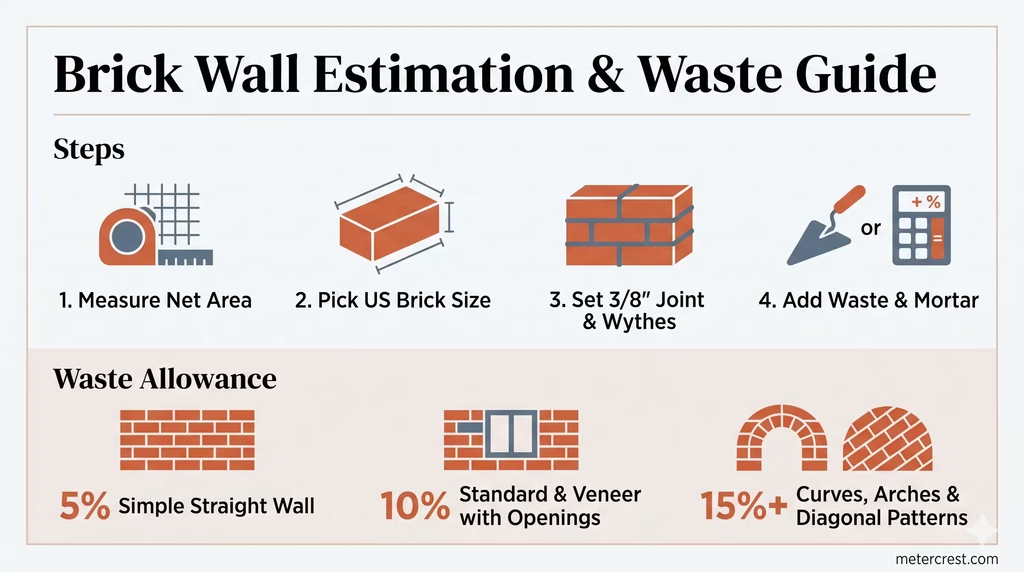
If you want a brick calculator for wall work you can trust, the order of the steps matters. Here's what I'd do:
- Measure the wall in sections. Take the length and height of each solid section in feet. A door, window, or gate opening isn't brick, so measure the solid sections on either side separately, or subtract the opening's area from the total.
- Pick your brick. Choose the US Modular or US Standard preset, or switch to custom dimensions for Queen, King, Norman, or any other size. If you already have bricks, measure three of them with a tape.
- Set the mortar joint. A 3/8-inch joint is the standard starting point for brickwork. Section R606.3.1 of the 2024 International Residential Code specifies 3/8-inch bed and head joints unless otherwise required or indicated on the construction drawings. Actual joint dimensions can vary depending on the project, so confirm them with your mason before calculating the final quantity.
- Choose your waste allowance. I use 5% for a simple wall and 10% for most real jobs. More on that below.
- Add prices if you want a cost estimate, then press calculate.
One habit I'd recommend: print the result or save it as a PDF and keep it with the supplier's quote. When the pallets arrive, you have a number to check against.
The Calculation of Bricks for Wall Projects: The Formula
Every calculation of bricks for wall work rests on one idea. It asks how many bricks fit into the wall face, with mortar included.
Bricks = net wall area ÷ face area of one brick, including its joint
The face area of one brick plus its joint is (brick length + joint) × (brick height + joint).
Take a US modular brick, 7-5/8 inches long and 2-1/4 inches tall, laid with a 3/8-inch joint. Add the joint to each dimension, and you get an effective unit of 8 × 2-5/8 inches, which is 21 square inches. Divide 144 square inches (one square foot) by 21, and you get about 6.86 bricks per square foot.
Now see what happens if someone forgets the mortar. The bare brick face is 17.16 square inches, so they'd calculate about 8.4 bricks per square foot. That's roughly 22% too many, from one forgotten variable. This is the main reason different websites give different answers for the same wall.
Wythes: Single, Double, and What They Do to Your Count?
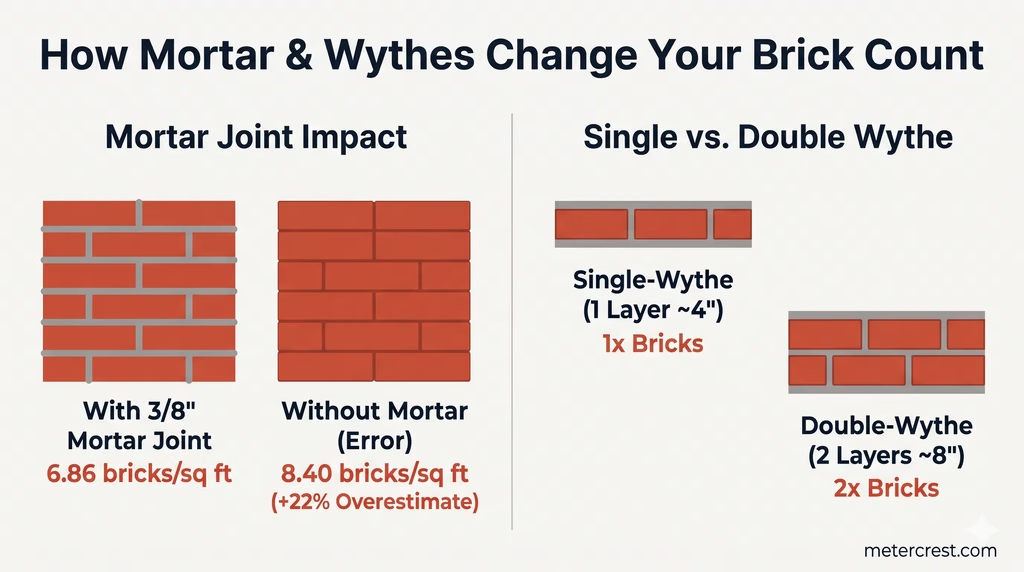
This is the idea that trips people up, so picture it.
A brick wall is described by its wythes, meaning the number of brick layers through its thickness. A single-wythe wall is one brick thick, which is about 4 inches with a modular brick. Brick veneer on a house front is single-wythe, and so are many garden walls.
A double-wythe wall is two bricks thick, about 8 inches, and it takes about twice as many bricks per square foot of wall face. Double-wythe and solid brick walls are structural systems, and the drawing decides which one applies, not the calculator.
Every per-square-foot figure on this page assumes a single wythe. If your wall is two bricks thick, double the number. If you don't know which you're building, ask your mason or engineer before you order.
Brick Wall Calculator Examples: Real Walls Worked by Hand
I trust numbers more when I can watch them being used. Here are two walls worked by hand. Run each one through the brick wall calculator above and compare.
Example 1: Brick veneer on a house front
Say I'm facing a house front 25 ft wide and 9 ft high, with two windows of 3 × 5 ft and a door of 3 × 7 ft.
- Gross area: 25 × 9 = 225 sq ft
- Openings: 30 + 21 = 51 sq ft
- Net area: 174 sq ft
- Modular brick at 6.86 per sq ft: 174 × 6.86 = 1,194 bricks
- With 10% waste: about 1,313 bricks
I use 10% here on purpose. Veneer has cuts around every window and door, and every cut leaves an offcut that usually can't be reused.
Brick veneer also involves installation requirements beyond the number of bricks. Under Section R703.8 of the 2024 International Residential Code, anchored masonry veneer over wood framing uses a nominal 1-inch air space between the sheathing and veneer. The code also specifies veneer tie spacing of up to 32 inches horizontally and 24 inches vertically, with each tie supporting no more than 2.67 square feet of wall area. Weep holes must be spaced no more than 33 inches apart. These details matter because a brick veneer estimate covers material quantities, not the complete installation requirements.
Veneer matters more than it used to, because it is how most brick now ends up on American houses. Brick or brick veneer covered only 16.8% of new single-family homes started in 2025, compared with almost a quarter in 2012. The homes that do use it are typically facing the house around many openings, which is exactly where the waste allowance earns its place.
Example 2: A backyard garden wall
Now a wall 24 ft long and 4 ft high, single wythe, built with standard brick (7-5/8 or 8 inches long), which runs at 6.55 per sq ft.
- Net area: 24 × 4 = 96 sq ft
- Bricks: 96 × 6.55 = 629
- With 10% waste: about 692 bricks
A freestanding wall also needs a footing, and that cost is easy to forget. Check your local code for the depth required in your area.
Calculator Bricks by US Size: Per-Square-Foot Reference
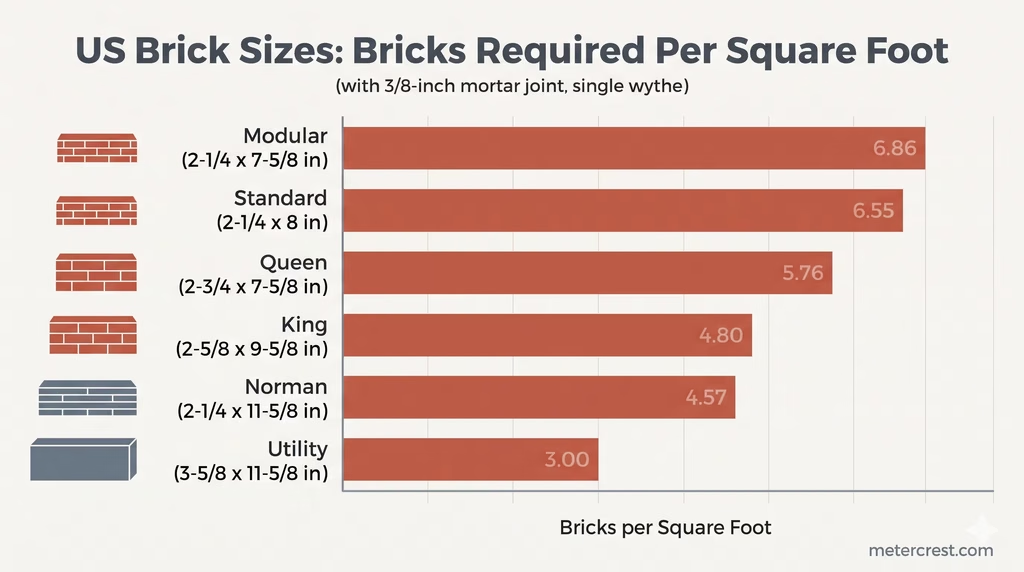
Americans use a lot of different brick sizes, and the size changes the count a lot. A calculator bricks tool is only as good as the size you give it. Here are the ones you'll run into most often:
| Brick type | Size (H × L, inches) | Bricks per sq ft |
| Modular | 2-1/4 × 7-5/8 | 6.86 |
| Standard | 2-1/4 × 8 | 6.55 |
| Queen / Engineer Modular | 2-3/4 × 7-5/8 | 5.76 |
| King | 2-5/8 × 9-5/8 | 4.8 |
| Norman | 2-1/4 × 11-5/8 | 4.57 |
| Utility | 3-5/8 × 11-5/8 | 3 |
All use a 3/8-inch joint and a single wythe. The same 100 sq ft wall takes about 686 modular bricks but only 300 Utility bricks, which is a bigger swing than most people expect. That is why every calculation brick wall estimate should begin with the exact brick you're buying, not a generic one.
Brick Calculator Square Feet: The Quick Rule of Thumb
Sometimes I just want a rough number before I open any tool. The quick brick calculator square feet check is:
Bricks ≈ wall area (sq ft) × bricks per sq ft
For US modular brick, I use about 6.9 per sq ft. For standard brick, about 6.5. (The quick-reference table above rounds modular to 6.8, while Glen-Gery's published figure is 6.86. The difference is under 1%.)
A quick example: a 100 sq ft single-wythe modular wall needs about 686 bricks. Add 10%, and you order roughly 755.
When you compare quotes, remember that suppliers often price brick per thousand. To convert, divide the price per thousand by 1,000 to get the price per brick, then multiply by the bricks per square foot.
For example, at $600 per thousand (an illustrative number), a modular brick costs $0.60, and covering a square foot costs about $4.12.
Wall Calculator Bricks: Mortar, Cement and Sand
Bricks are the visible cost, but a wall needs mortar, and forgetting it is how people end up making a second trip to the supplier. A good wall calculator bricks tool should work out mortar too, and this one does.
It estimates mortar from the wall volume minus the volume of the bricks, then converts that into dry cement and sand using two settings you control: the cement-to-sand ratio and a dry-volume bulking factor, because dry materials shrink when they are wetted and compacted.
Two real-world cross-checks I use:
- Volume. Glen-Garry's size data puts mortar at about 8 cubic feet per 1,000 modular bricks, using a 3/8-inch joint. A single-wythe wall of that size contains about 8.06 cubic feet of mortar per 1,000 modular bricks.
- Bags. One 80-pound bag of masonry cement, mixed 1:3 with sand, lays about 135 standard modular bricks and needs about 3 cubic feet of sand. So 1,000 bricks come to about 7 to 8 bags and about 22 cubic feet of sand.
For the 629-brick garden wall above, that works out to about 5 bags of masonry cement and about 15 cubic feet of sand. I'd buy 5 or 6 bags, because mortar waste is real, and a half-empty bag is cheaper than a work stoppage.
If you buy pre-mixed mortar instead, it goes further per bag in count but costs more per brick. One mortar calculator puts an 80-lb bag at about 35 to 40 modular bricks, or roughly 26 to 28 bags per 1,000.
One conversion note. The calculator's cement price field is per 50 kg bag. A 50 kg bag is about 110 lb, so it's roughly 1.4 of the 80-lb bags sold at US supply yards. Adjust your price entry to match, or use the bag counts above as a cross-check.
Joint thickness moves these numbers more than you'd expect. A 1/2-inch joint instead of 3/8 adds noticeably more mortar over a whole wall. And dry, absorbent brick pulls water out of mortar, which weakens the joints. That is a site-practice issue no calculator can solve.
Brick Wall Cost Calculator: What Will It Actually Cost?
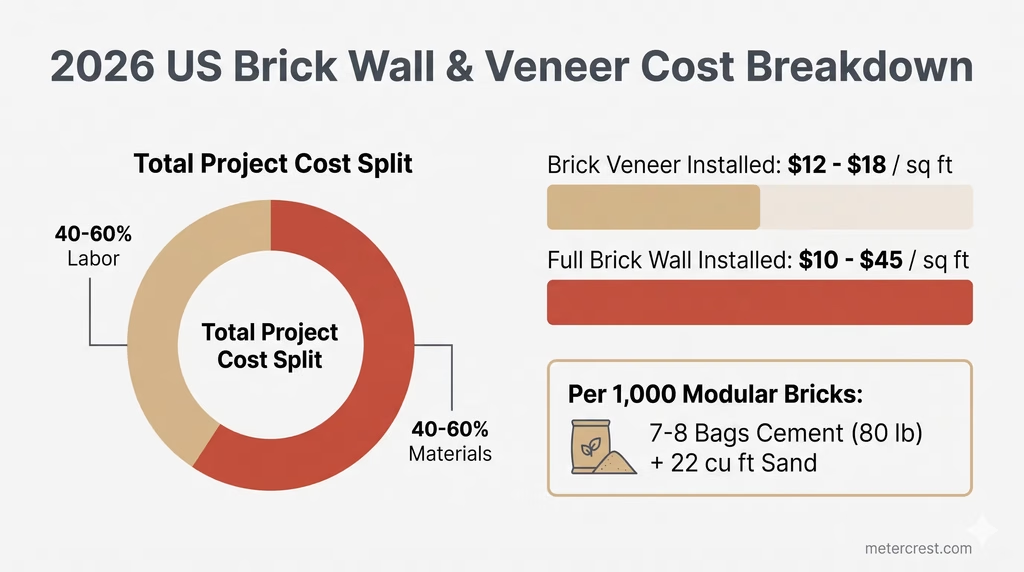
The brick wall cost calculator section is optional. It takes three prices: brick, cement (per bag), and sand (per cubic foot or cubic meter). Pick USD or any of nine other currencies, and it totals the three materials.
It doesn't include labor, equipment, footings, or delivery, and in masonry, labor is a large part of the bill. Fixr estimates that labor typically makes up 40 to 60% of total project cost.
For context, here are 2026 US benchmarks:
- Brick veneer: HomeGuide puts full-size brick veneer at $12 to $18 per square foot installed, with the bricks themselves costing about $2 to $6 per square foot and labor about $5 to $7.
- Brick walls: Angi reports that the national average to build a brick wall in 2026 is $5,000, with most homeowners paying $10 to $45 per square foot.
Let me turn that into an example. My 174 sq ft veneer front at $12 to $18 per sq ft installed comes to about $2,088 to $3,132. If I price only the bricks, $2 to $6 per sq ft works out to about $0.29 to $0.87 per modular brick, or roughly $290 to $870 per thousand.
The wide ranges are the point. Price swings come from brick type, wall height, access, local labor rates, and how much cutting the design involves. Use the calculator for quantities, and use a local written quote for prices.
Calculator Brick Wall: How Much Waste Should You Add?
I think of waste as insurance, and I choose the amount by how risky the job is. For any calculator brick wall estimate, these are the figures I use:
- About 5% for a simple straight wall with careful handling.
- About 10% for most real jobs, and always for veneer with openings.
- 15% or more for diagonal patterns, curves, arches, or walls with many corners and angles.
Here's why I don't recommend ordering the exact theoretical number. Say the calculator gives 629 bricks and I order exactly that. A few break on unloading, a few get cut badly near a corner, and I'm 25 short.
A top-up costs a delivery fee, and it may come from another production lot with a different color. Ten percent on this wall is 63 extra bricks, which usually costs less than one extra delivery. Ask your supplier to fill the whole order from one lot, and keep the leftovers for future repairs.
Brick Paver Calculator: Patios, Walkways and Driveways
A brick paver calculator works differently from a wall tool. Pavers are laid flat, so the face you cover is the large side. The formula is:
Pavers = area ÷ ((paver length + joint) × (paver width + joint))
Glen-Gery lists the common modular paver (3-5/8 × 7-5/8 inches, 3/8-inch joint) at 4.50 pieces per square foot, and the same figure for a 4 × 8 paver.
Say I'm laying a 12 ft × 16 ft patio:
- Area: 192 sq ft
- Pavers: 192 × 4.5 = 864
- With 10% for cuts: about 950
Herringbone and curved edges mean more cutting, so I'd go higher there.
Remember the layers underneath. A bedding layer of about 1 inch of sand over 192 sq ft is roughly 16 cubic feet.
Under that, you need a compacted base, and the depth depends on your soil and the load: a walkway needs far less than a driveway. Check local guidance before you order.
Calculator Bricks: When to Double-Check the Estimate
Whatever calculator bricks tool you use, treat the result as a very good planning number, not a guarantee. A few things change the real count:
- Bond pattern. Running bond is the baseline. Fancier patterns can use more cuts.
- Wythe count. Every per-square-foot figure here assumes one wythe.
- Actual joint width. A mason laying 1/2-inch joints will need fewer bricks than one laying 1/4-inch.
- Brick tolerances. Handmade and oversize bricks vary more than machine-made, so measure them.
Bond pattern also has structural requirements. Section R606.3.7.1 of the 2024 International Residential Code requires head joints in successive courses of running-bond masonry to be offset by at least one-quarter of the masonry unit's length, unless the specified alternative reinforcement provisions are followed. A quantity calculator can estimate the units needed, but the bond pattern and reinforcement details should be confirmed against the project drawings.
Important: This brick calculator provides material estimates based on the dimensions, brick size, mortar joint, and waste percentage you enter. It does not replace structural drawings, engineering calculations, local building-code checks, or a contractor's assessment. For load-bearing walls, retaining walls, and structural masonry, consult a qualified professional before construction.
FAQs
How many bricks do I need per square foot?
About 6.86 for modular brick and 6.55 for standard brick, using a 3/8-inch joint and a single wythe. Larger bricks need fewer: Queen about 5.76, King about 4.80.
How many bricks do I need for 100 square feet?
About 686 modular bricks or 655 standard bricks, before waste. With 10% waste, order roughly 755 or 720.
How do I use a brick wall calculator for a wall with doors and windows?
Split the wall into solid sections and enter each one, or subtract each opening's area from the total before entering the dimensions. Don't count openings as brick.
How many bags of mortar do I need for 1,000 bricks?
About 7 to 8 bags (80 lb) of masonry cement plus about 22 cubic feet of sand, or roughly 26 to 28 bags of pre-mixed mortar.
How much waste should I add?
About 5% for a simple wall, 10% for most jobs and veneer, and 15% or more for angled or patterned work
How much does it cost to build a brick wall?
Most 2026 guides put brick walls at $10 to $45 per square foot installed, and brick veneer at about $12 to $18. Your local quote is what counts.
How many pavers do I need for a patio?
Multiply the area in square feet by about 4.5 for a standard modular paver, then add 10% for cuts.
Does the calculator work with Queen, King, or Norman brick?
Yes. Use custom dimensions and enter the brick's length, height, and width, plus your joint.